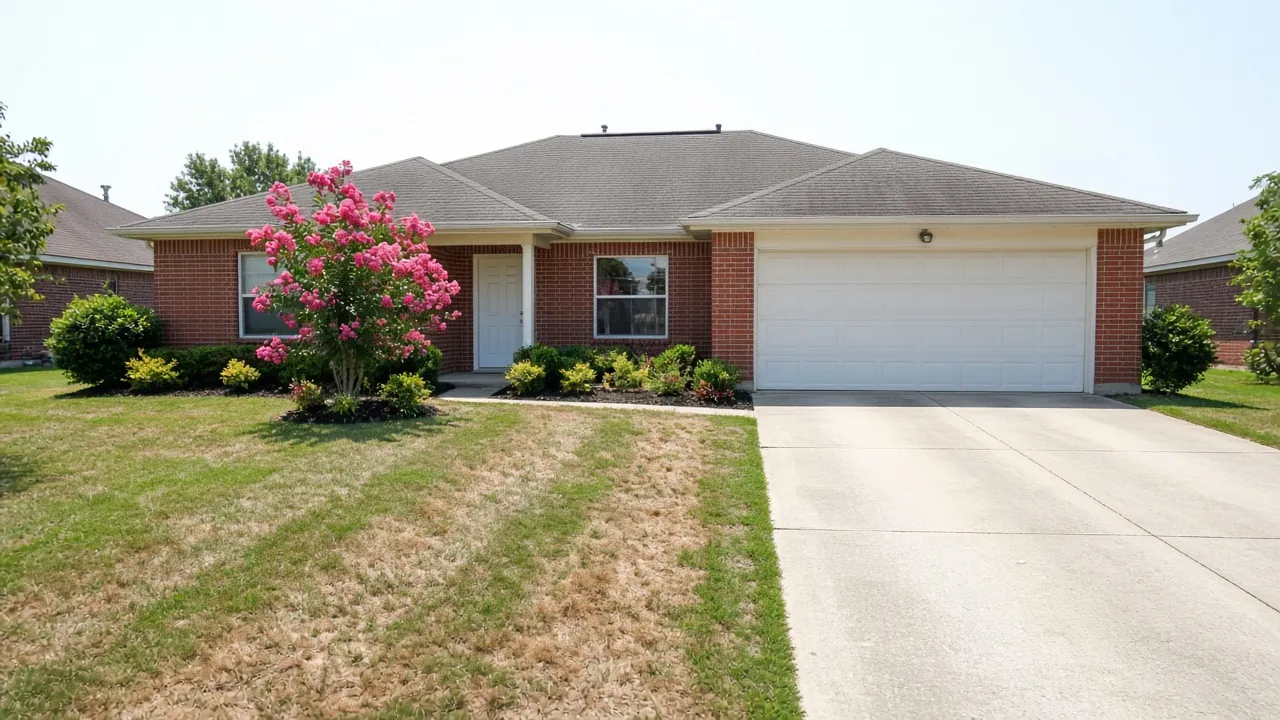
A lawn that is green in some places and brown in others is telling you something about how water is landing on it. Before you add more water to the whole yard, look at the shape and location of the brown areas. The pattern usually points straight at the cause.
The catch-can test
The best way to see how evenly a zone waters is to measure it. Set out six to ten straight-sided containers (tuna cans, plastic cups) scattered across the zone, including near the heads, between the heads and in the brown area. Run the zone for 15 minutes. Then measure the depth in each one.
If one can has a half inch and another has almost nothing, you have found your problem. Even watering means the cans are fairly close to each other.
Pattern: brown stripe along a driveway or sidewalk
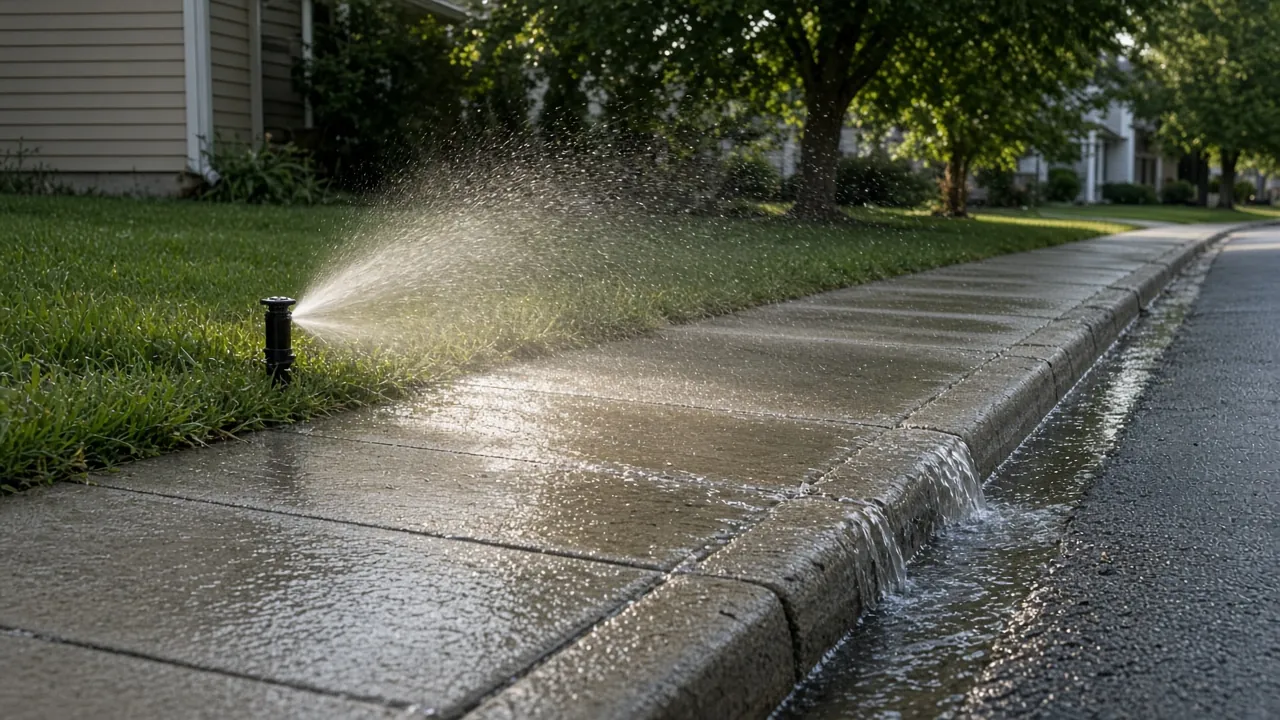
This is the most common brown area we see in Dallas lawns. The edge next to the pavement dries out first because:
- Concrete heats up and dries the adjacent soil
- Edge heads are often half-circle or quarter-circle heads that may be broken, turned, or clogged
- Edge heads sometimes have nozzles that do not match the rest of the zone
- A head along the drive may have been crushed by a car and replaced with the wrong part
Check that every edge head rises, sprays its full arc toward the lawn, and has a matched nozzle. Head-to-head coverage, where each head’s spray reaches the next head, is what keeps edges green.
Pattern: brown circle or doughnut around a head
A green ring right at a head with brown beyond it usually means the head is not throwing water as far as it should. Causes include a sunk head, a clogged nozzle, low pressure on the zone, or the head being blocked by grass. A brown ring right at a head with green beyond can mean the opposite: the head sprays over the area right in front of it.
Pattern: brown between heads
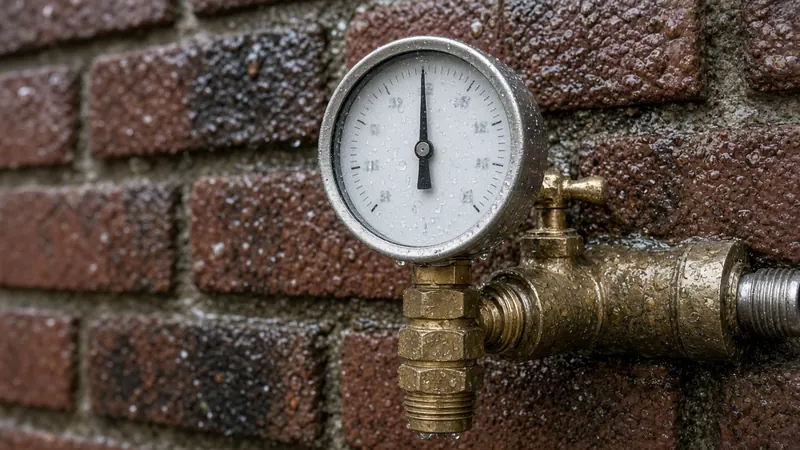
If the areas midway between heads brown, the heads may be spaced too far apart for their nozzles, or pressure on the zone may be too low for full throw. Weak pressure can come from a leak, too many heads, or a valve not opening fully. See why heads stop popping up.
Pattern: one whole zone browning
If the brown area matches the shape of a zone, the zone may not be running at all (a valve or wire problem), may be set with too little time, or may be blocked by a failing valve. Run it manually and watch.
Pattern: brown at the top of a slope, soggy at the bottom
That is runoff. The water applied at the top runs downhill before it soaks in. Cycle and soak is the fix.
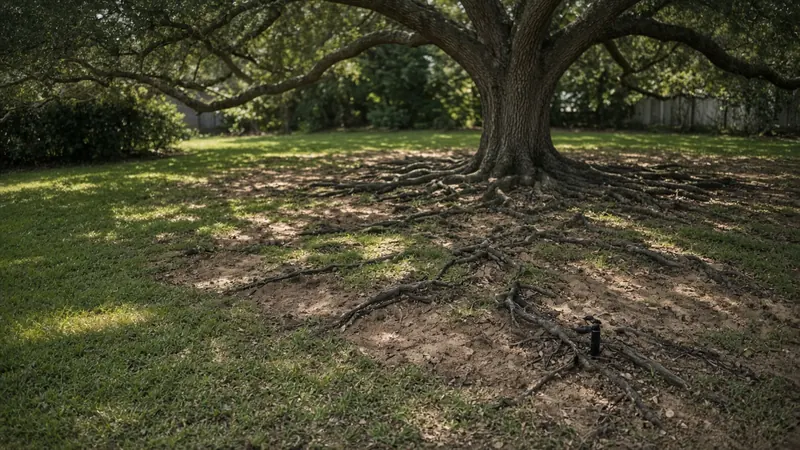
Pattern: thin brown grass under trees
Grass under big oaks and pecans often struggles from shade, root competition, or too much water rather than too little. See watering lawns under trees.
When it is not the sprinklers
Not every brown spot is a watering problem. A few others to know:
Fungal disease. St. Augustine in Dallas is prone to fungal diseases like brown patch (also called large patch) in cooler, wet weather in spring and fall. It forms circular patches that can grow quickly. Overwatering, watering in the evening and nitrogen at the wrong time can make it worse.
Chinch bugs. These insects attack St. Augustine in hot, dry weather, often starting in the sunniest spots near pavement. The edge of the damage has yellowing grass, and you may see the tiny insects at the soil line.
Grubs. White grubs feed on roots. Damaged turf pulls up easily like a loose carpet.
Dog spots and chemical spills. Small, very defined dead spots, sometimes with a green ring, are often from pets or spilled fuel or fertilizer.
The Texas A&M AgriLife Extension Service publishes guides for diagnosing turf problems if you suspect disease or insects.
Why adding more water to everything is the wrong fix
When part of a lawn browns, the natural reaction is to turn up the run time for the whole zone or the whole system. That keeps the brown area a little greener, but it overwaters everything else, increases the risk of fungal disease, raises your bill, and may push the schedule past the hours allowed by the Dallas ordinance. Fixing the coverage problem lets you water less overall.
What we do on a visit
We run the zones, look at every head, check pressure and coverage, and usually run a few catch cans in the problem area. Typical fixes include replacing and matching nozzles, raising sunk heads, re-aiming heads, replacing broken edge heads, repairing a leak that is starving a zone, and splitting an overloaded zone. Then we set the schedule so the whole lawn gets about the same amount.
Call us
If part of your lawn is browning and the rest is fine, call 469-208-4222. The fix is often a few heads and nozzles, not more water.
Sources
Have a question this did not answer? Call 469-208-4222 and ask. More articles on the blog.