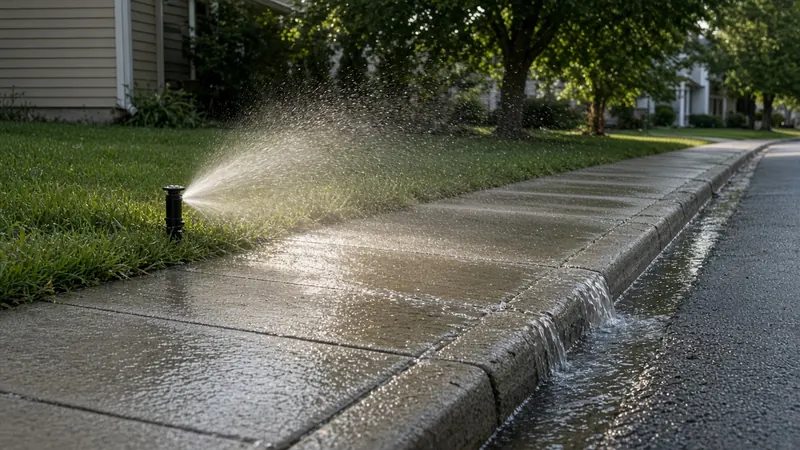
Walk outside the next time your sprinklers run and watch the low end of the lawn. If water starts running across the sidewalk and down the gutter before the zone shuts off, you are watching most of your water bill leave. On Dallas clay, that is extremely common. The fix is called cycle and soak, and almost any controller can do it.
Why water runs off clay
Every sprinkler head puts water down at a certain rate, measured in inches per hour. Typical fixed spray heads apply water quickly, often more than an inch per hour. Rotors are slower. Clay soil, on the other hand, absorbs water slowly, especially once the surface is wet. When the sprinkler puts water down faster than the soil can take it in, the extra sits on top and flows downhill.
On a flat lawn you might just see puddles. On a slope, like many yards in Lake Highlands, Lakewood and along the creeks, the water heads straight for the street. The top of the slope stays dry, the bottom stays soggy, and the City of Dallas ordinance counts the runoff as waste.
What cycle and soak means
Instead of running a zone once for 24 minutes, you run it three times for 8 minutes, with time in between. During the first cycle the soil surface wets and starts absorbing. During the rest, that water moves down. The next cycle lands on soil that is ready to take more. The total amount of water is the same. The amount that actually reaches the roots is much higher.

How to set it up on a typical controller
Most controllers handle this with multiple start times on one program.
- Figure out how long each zone runs now. Write it down for each zone.
- Divide by two or three. A spray zone at 18 minutes becomes three cycles of 6 minutes. A rotor zone at 36 minutes might become two cycles of 18 minutes.
- Set the new, shorter run times for each zone.
- Add more start times to the same program. If you have six zones at 6 minutes, one pass takes 36 minutes. Set start times at 4:00, 4:45 and 5:30 a.m. Each zone gets about 40 minutes of rest between cycles.
- Check the total. The last start plus one full pass has to finish before 10 a.m. under the Dallas rules.
- Watch it run once. If you still see runoff, shorten cycles further and add a fourth start.
Many newer controllers have a built-in cycle and soak setting per zone, where you enter a maximum cycle time and minimum soak time and the controller does the math. Smart controllers often do this automatically if the soil type and slope are set correctly for each zone.
How much water is enough
There is no single right number, but a few rules of thumb help. Established warm-season lawns in Dallas, like St. Augustine and Bermuda, do well with about an inch of water a week in the heat of summer, less in spring and fall, and very little in winter. Rainfall counts toward that.
To find out how much a zone puts down, set out a few straight-sided cans or cups in the zone, run it for a set time, and measure the depth. That tells you the zone’s application rate. If 15 minutes puts down a quarter inch, then two watering days of 30 minutes total each gives about an inch a week. Split each day’s 30 minutes into three cycles.
Signs cycle and soak will help you
- Water reaches the sidewalk or gutter before a zone finishes
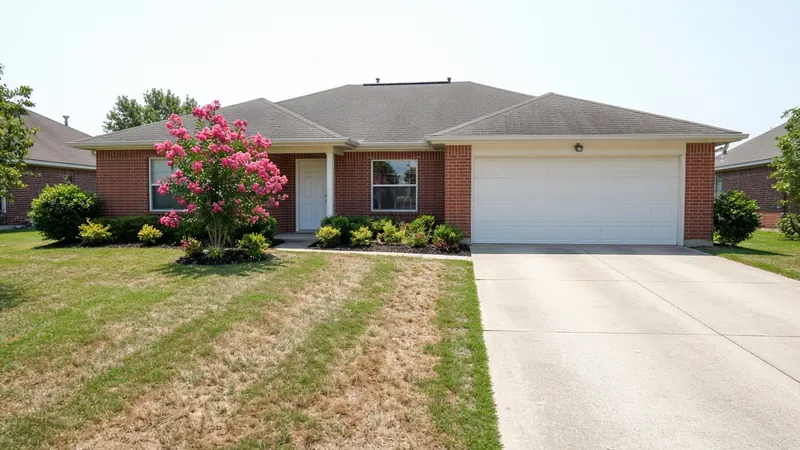
- The bottom of a slope is soggy while the top is dry and brown
- Puddles stand in low spots after watering
- Grass along the curb and driveway is thin
- Your water bill is high but the lawn still has dry patches
When the schedule is not the whole problem
Sometimes runoff is a sign of something else: a head tilted toward the street, a broken head pouring water into one spot, mixed nozzles putting down far more water in one part of the zone, or a valve that does not shut fully and leaks to the lowest head. If you set up cycle and soak and still see water collecting in one spot, look for a mechanical problem. Our articles on brown spots in a watered lawn and finding a sprinkler leak cover the most common ones.
Rotors versus sprays
Rotor heads apply water much more slowly than sprays, so they cause less runoff. That is one reason they are a good fit for larger lawns on clay. But spray zones and rotor zones should never be mixed on the same valve, because they apply water at such different rates. If you find sprays and rotors together on a zone, that zone will never water evenly no matter how you schedule it.
Some spray heads can be fitted with high-efficiency nozzles that put down water more slowly in rotating streams. Swapping nozzles on a spray zone can cut runoff a lot without changing the pipe.
Seasonal adjustment
Cycle and soak deals with how the water goes down. Seasonal adjustment deals with how much. In spring and fall, use the controller’s percentage or water budget feature to cut run times across the board. In a rainy week, turn it off. The Dallas rain sensor requirement exists for exactly this. See our article on sensors.
Want it set up for you
If you want help, call 469-208-4222. On any repair visit we can measure your zones, set cycle and soak, and fit the program inside the Dallas schedule. It is often the single biggest improvement to how a lawn looks, and it costs nothing in parts.
Sources
Have a question this did not answer? Call 469-208-4222 and ask. More articles on the blog.