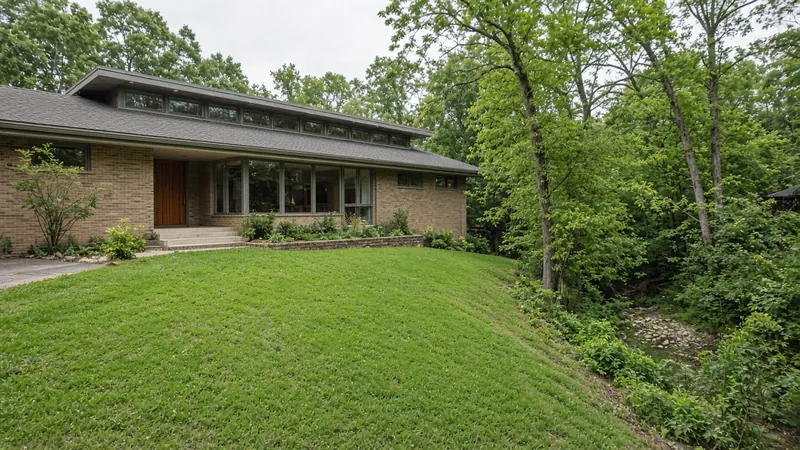
If you live inside the City of Dallas, your sprinkler system is covered by the city’s water conservation ordinance. The rules are not complicated, but they are easy to break without noticing, especially if the controller was programmed by a previous owner or a builder years ago. This article goes through each rule, why it exists, and what it means for the way your system should be set up.
The city’s own summary is the authority, and rules can change, so check the City of Dallas water conservation ordinance page if anything here looks different from what you have heard.
Rule one: no more than twice a week
Automatic sprinklers may run at most two days a week, and the days depend on your address. According to the city’s schedule, even-numbered addresses water on Sunday and Thursday, and odd-numbered addresses water on Wednesday and Saturday. Nobody runs sprinklers on Monday, Tuesday or Friday.
Two days a week is enough for an established Dallas lawn almost all year, as long as each watering day puts down a good amount of water and that water soaks in. The problem is usually not the number of days. It is how the water goes down on those days. A zone that runs 30 minutes straight on clay soil sheds a lot of its water before the ground can absorb it. More on that below.
Rule two: nothing between 10 a.m. and 6 p.m.
Sprinklers may not run between 10 a.m. and 6 p.m. on any day of the year. Water sprayed into the air in the heat of the day evaporates and blows away before it reaches the roots. The city would rather you put that water down in the early morning, when it is calm and cool.
This rule catches people because of how controllers add up time. Say you set a start time of 6 a.m. and have eight zones at 20 minutes each, plus a second program someone added years ago. That is easily three or four hours, and the last zones are now running after 10 a.m. Always add up the total run time of every program and make sure the whole thing finishes before 10.
Rule three: hand watering and soaker hoses are allowed any day
The twice-a-week limit applies to sprinklers. Hand watering with a hose and running soaker hoses are permitted on any day. If you have drip zones on the controller, check the city’s current rules before running them outside your sprinkler days. This matters for new plantings, pots and the hot spots along driveways and south walls that dry out first.
Rule four: rain and freeze sensors are required
Automatic sprinkler systems in Dallas must have rain and freeze sensors installed. A rain sensor stops the system from running during or right after rain. A freeze sensor stops it when temperatures are near freezing, so the system does not coat sidewalks and streets with ice.
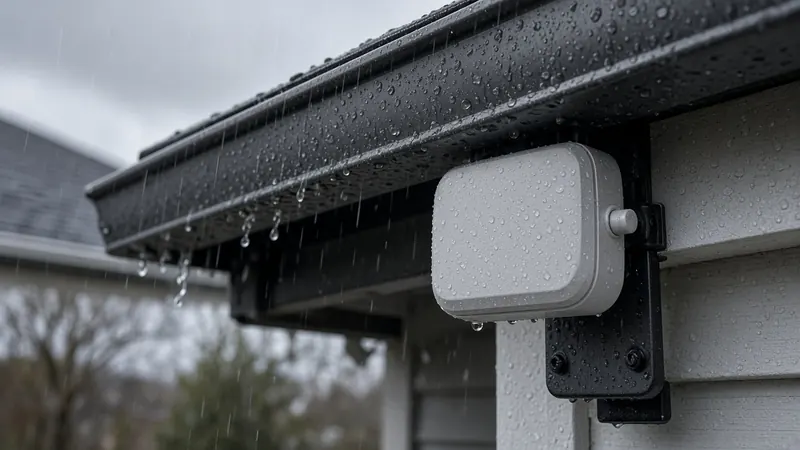
Many older systems never had sensors, and on many others the sensor is disconnected, broken or bypassed at the controller. If yours has a small device mounted on a fence, gutter or eave, it is probably a sensor. Whether it still works is another question. We test them on every repair visit. Read more in our article on rain and freeze sensors.
Rule five: maintain the system and do not water pavement
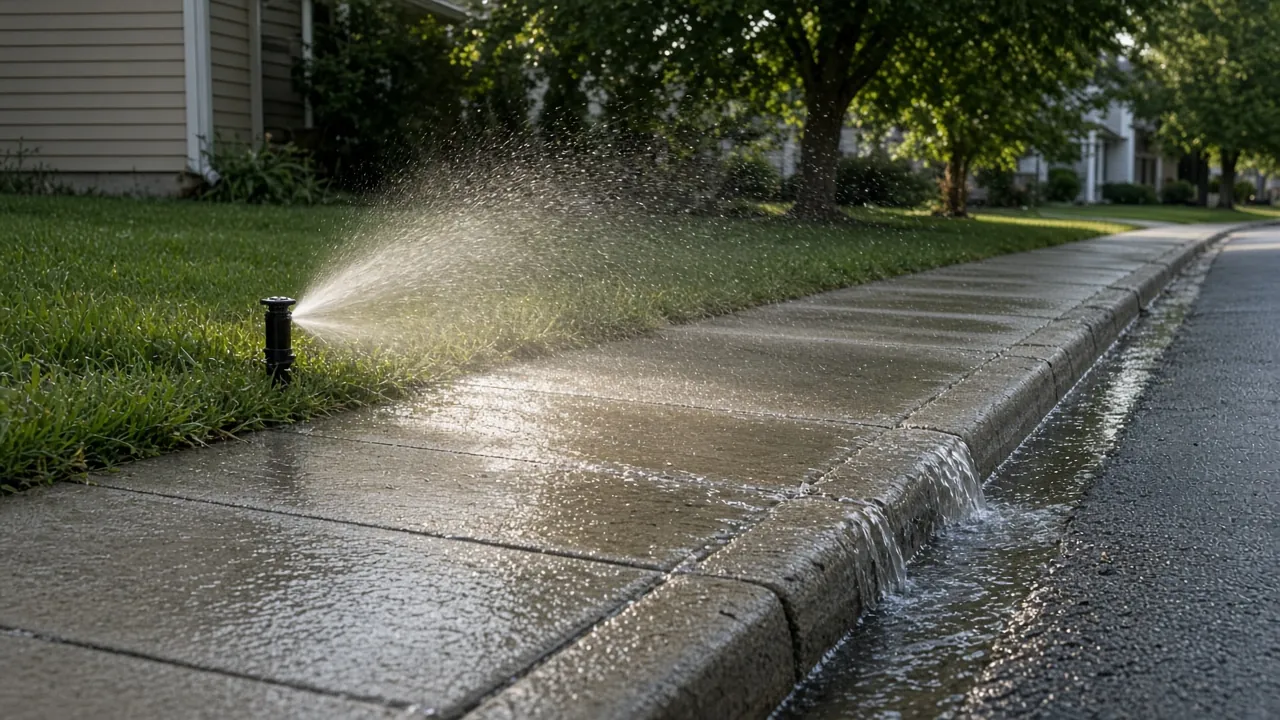
The ordinance asks owners to repair broken, missing or misdirected heads. It bans watering during precipitation, watering driveways, sidewalks and streets, and letting water run off into the street or a drainage area.
That makes repair part of compliance. A broken head geysering into the air, a head turned toward the street, a spray zone on a narrow parkway that soaks the sidewalk: each of these is a violation as well as a waste. See how to stop sprinkler overspray for the usual fixes.
Fines
The city’s summary says violations can result in fines of $250 to $2,000 per incident, and first offenses get a warning. Most homeowners who get a warning are surprised by it. The controller was running at noon because of an old second program, or a head broke and nobody noticed. Fixing the cause is usually simple.
Setting your controller for the rules
Here is a practical way to set a typical Dallas system so it follows the ordinance and waters well:
- Pick your two days. Even address: Sunday and Thursday. Odd address: Wednesday and Saturday.
- Use one program if you can. Multiple programs are where extra run time hides. Delete the ones you do not need.
- Start early. A start time around 4 or 5 a.m. gives a long window before 10.
- Split run times into cycles. On clay, set each spray zone for two or three short cycles instead of one long one. Many controllers let you set multiple start times; the zones then run in sequence and each zone gets a rest between cycles.
- Adjust by season. Use the controller’s seasonal adjustment or water budget feature to turn things down in spring and fall. Many weeks in winter the system can be off.
- Check the sensor. Make sure it is connected and active, not bypassed.

Why the rules make sense for your lawn too
It is easy to think of the ordinance as something the city wants and your lawn does not. In practice the rules line up with good watering. Deep, infrequent watering pushes grass roots down into the soil, where they find moisture during hot spells. Frequent shallow watering keeps roots near the surface and makes lawns more vulnerable in August. Early morning watering lets leaves dry during the day, which helps reduce fungal problems in St. Augustine. And a system that does not water the street is a system that puts its water on the lawn.
New lawns and special cases
If you have just put in new sod or seed, it needs more frequent watering for a few weeks than the twice-a-week schedule allows. The city’s ordinance page mentions a process to request an exemption or variance. Check the current requirements with the city before you start, and remember that hand watering is allowed any day. Our article on watering new sod in Dallas covers how to get new grass rooted.
Outside the city limits
Richardson, Garland, Mesquite and other neighboring cities set their own rules. They are often similar, but the days and details can differ. If your water bill comes from a different city, follow that city’s schedule.
When to call
If you are not sure your controller is set correctly, or a zone is running when it should not, call us at 469-208-4222. Setting the schedule and testing the sensors takes a few minutes on any repair visit, and it is one of the simplest ways to cut water waste.
Sources
- City of Dallas Water Conservation Ordinance summary, Save Dallas Water
- Save Dallas Water frequently asked questions
Have a question this did not answer? Call 469-208-4222 and ask. More articles on the blog.